- Blog
- >
- The Hidden Cost of Running Your Team on Good Intentions
Last updated: September 17, 2026
The Hidden Cost of Running Your Team on Good Intentions
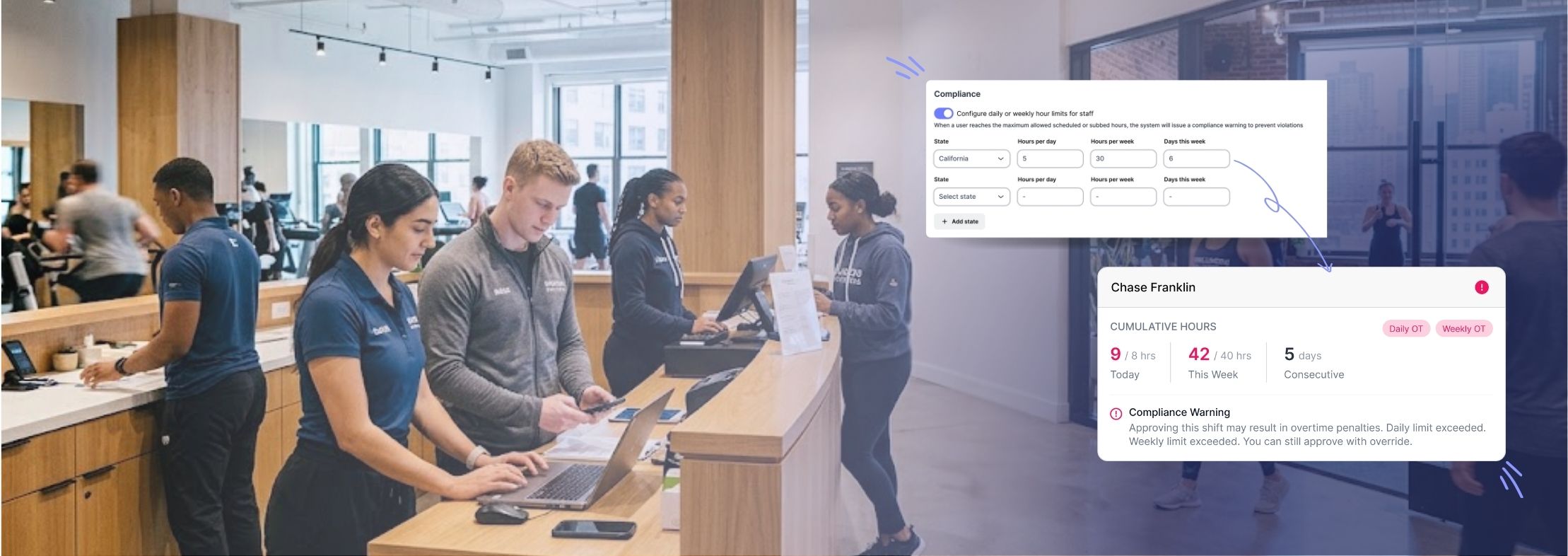
Passion built your business. But it won't schedule your team, protect your payroll, or keep you on the right side of labor law...
The fitness industry grew out of passion, not “business best practices” or “corporate processes.” Most of us started with a schedule taped to a wall, a group text for coverage, and a handful of instructors we trusted to “just get” how things worked and how to do their jobs well. It was personal, it was scrappy, and for a while, it was enough…
But the businesses pulling ahead right now have all quietly made the same shift: they stopped treating it as a passionate hustle and started treating it as a business. That meant they stopped managing their teams on good intentions and hopes, and started managing them with real employment and staff ops systems. Not because they lost the heart and the passion but because they realized the heart doesn’t scale without the structure, and their employees need more than a shared passion to take home at the end of the day.
Here’s the uncomfortable truth: the way you employ your team is a leadership decision, and right now a big part of it is probably being made by accident.
Why It Matters More Than It Used To
You can’t lead a modern team without systems underneath you, whether you run one location or seven. Your people are savvy and distracted, juggling multiple jobs and endless notifications competing for their attention. How they show up for you comes down to whether they feel secure: whether they know what’s expected, trust they’ll be paid correctly and treated fairly, and can see you’re running a real business that takes their livelihood as seriously as they take it.
When you treat your business like a business, your team does the same: “they’ll just get it” becomes “here’s exactly how it works,” the only version that holds up when you’re not in the room. It’s also the version that finally answers the question every operator asks: why can’t my team just do what I need? The leadership qualities we all name, accountability, transparency, consistency, trust, can’t just live in your head; in a part-time, async industry, they have to be built into how the business runs. The gap between great and scattered leadership is usually a systems problem, and systems problems have solutions.
Where Good Intentions Get Expensive
a.k.a. The Blind Spots Hiding in Your Schedule
That type of team culture, the kind that makes each person feel safe, secure, treated like a real employee, can’t just come from a mission statement or a set of values. It has to be baked into how you run the business every single day: whether you schedule and pay people by the book.
Not prioritizing professionalizing your staff ops is more expensive than it looks. And nowhere is that more true than labor law, which in this industry hides inside the thing you do every single day: scheduling and subbing.
Think about how easily these happen:
- An instructor picks up a couple of subs on top of their regular classes and quietly crosses into overtime… and nobody notices until payroll.
- A part-timer works across two of your locations, and no single manager sees the total hours adding up to a threshold you just tripped.
- A last-minute schedule change trips a predictive-scheduling (“fair workweek”) rule in a city that requires advance notice and now there’s a penalty attached.
None of these are acts of bad character, or because you’re trying to take advantage of your employees or skirt the law. They’re the natural byproduct of running a fast-moving, multi-location, part-time-heavy operation on memory and good intentions. And the rules aren’t getting simpler. They’re layered, local, and constantly shifting, so the same system that’s fine in one location can be risky in another.
But the fines are only the cost you can see. The quieter one is your people: the best instructors have options, and they leave the operation that feels chaotic and careless for the one that feels like it has its act together. Every blown paycheck or last-minute scramble is a small signal about whether you’re a business worth staying with. The more you grow, the more both kinds of gaps quietly compound.
What Professionalizing Actually Looks Like
You don’t need an HR department. You need a few systems doing quiet, consistent work in the background:
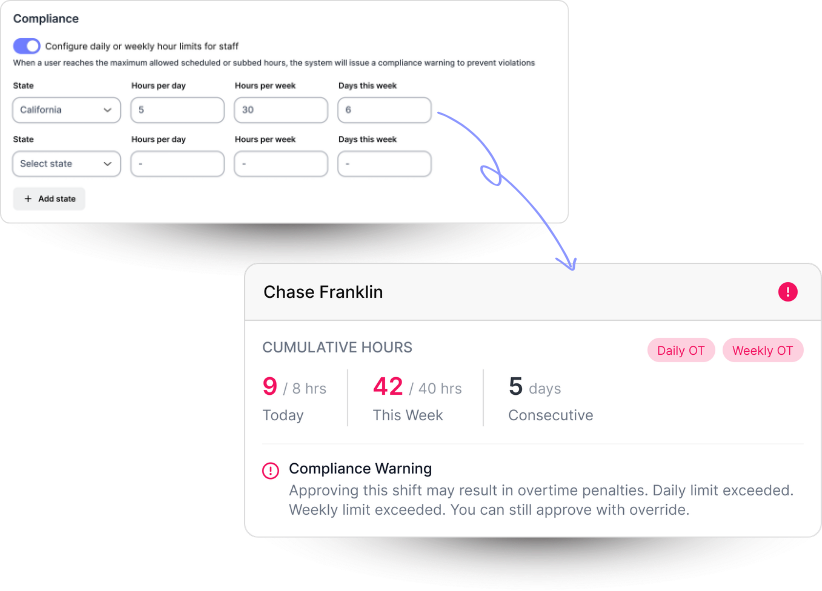
- Guardrails on the schedule, not just a rearview mirror. The point isn’t to find out about an overtime problem after payroll runs. It’s to be warned while you’re building the schedule or approving the sub, when you can still fix it.
- One view across every location. Compliance risk often lives in the totals no single manager sees. Hours, thresholds, and coverage need to roll up across all your sites, not sit in separate silos.
- Consistent, role-specific expectations. Every person should know what “good” looks like for their role, and every new hire should get the same foundation regardless of who onboarded them.
- A record you can lead from. When it’s time for a review, a raise, or a hard staffing call, decisions should rest on visible patterns and documented history, not memory, vibes, or gut.
Leading People Is the Hard Part, The Systems Shouldn't Be
That’s what NetGym’s new overtime compliance alerts are built for: they watch your scheduling and subbing and flag overtime, predictive-scheduling, and multi-location risks in real time — before they hit payroll or become a violation. But the alerts were never the point. What they free up is. When the systems hold the line and compliance risk is handled in the background, your time stops going to the work a system can do — and goes to the work no system ever will: leading your people. That’s what everything we build is in service of: not automating leadership, but clearing the way for it.
Professionalizing employment isn’t a step away from the community and heart that got you here. It’s how you protect them. Real guardrails, clear expectations, and a system that catches risk before it becomes a fine are what let a passionate, scrappy operation grow into a durable, respected business — without losing what made it special.
Great leadership, made operational. That’s the whole game.
Make Great Leadership Operational
Book a Demo to see how NetGym helps you build the employment systems, and the labor-compliance guardrails, your team and your business deserve.